
Japan vs. Belgium at the 2018 World Cup remains a defining case study in tactical naivety and ruthless efficiency. With 25 minutes left。Japan led 2-0, pressing high and exploiting space. Then Belgium switched to a direct 3-4-3, scoring three goals in 25 minutes, the winner coming from a 95-meter counterattack in the final seconds. That collapse wasn't physical;it was structural—Japan lacked a plan for game management, while Belgium’s golden generation had learned to win ugly.
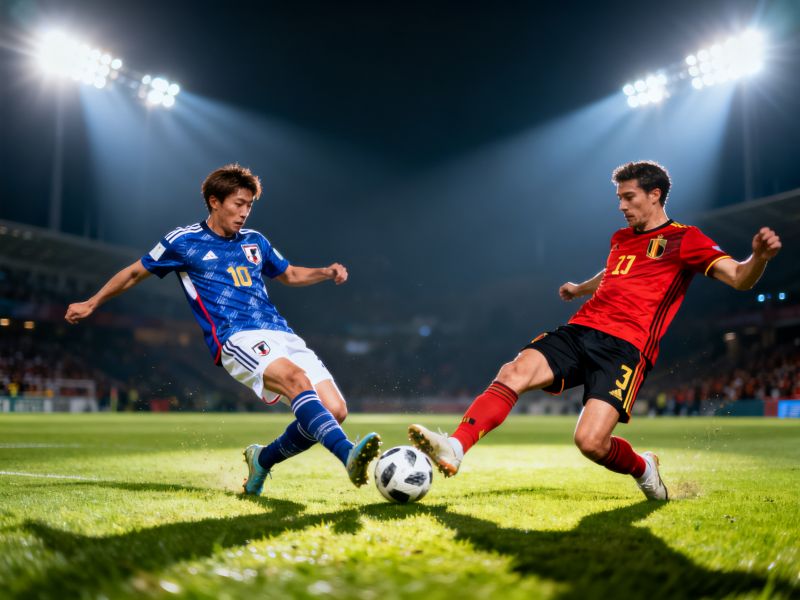
Belgium’s player development pipeline dwarfs Japan’s in raw output. The Belgian FA’s 2000s overhaul centralized youth training, producing Thibaut Courtois, Eden Hazard, Kevin De Bruyne—all from a small nation of 11.5 million. Japan, with 125 million people, still struggles to produce elite forwards. The J.League’s emphasis on collective discipline and technical homogeneity creates solid teams but few difference-makers. Take Takefusa Kubo: prodigious at La Masia, yet his club career has been a series of loans. Belgium’s Romelu Lukaku, by contrast。was given a clear pathway from Anderlecht to Chelsea. It’s not about talent;it’s about ruthless exposure to high-stakes environments.Belgium’s golden generation also revealed a flaw: they never won a major trophy. Japan, meanwhile, has quietly built a more sustainable model. The 2022 World Cup wins over Germany and Spain weren’t flukes—they came from a deliberate shift to a high-press 3-4-3。mirroring Belgium’s 2018 comeback but with better structural discipline. Japan’s domestic league cap on foreign players forces clubs to develop local talent, and the national team’s 2023 friendly win over Germany in Wolfsburg showed a newfound capacity to close out games. Belgium’s reliance on individual brilliance has waned;Japan’s collective engine is ascending.
On a granular level, the Japan vs. Belgium contrast extends to fan culture and media pressure. Belgian fans expect flair and are quick to turn on coaches—Roberto Martínez faced constant criticism despite a 71% win rate. Japanese fans are more patient, but that patience can mask tactical conservatism. The Samurai Blue’s 2022 loss to Croatia on penalties exposed lingering issues with in-game decision-making under pressure. Belgium’s Nations League draw with Austria in 2023 showed similar cracks: aging defenders。a lack of fresh legs. Both federations now invest in data analytics, but Japan’s approach is more systematic, embedding sports science into youth academies rather than buying ready-made solutions.Projecting forward, Japan vs. Belgium might become a rivalry of equals by 2026. Belgium’s new generation—Romeo Lavia, Jérémy Doku—brings energy but lacks tournament experience. Japan’s squad。
anchored by Kaoru Mitoma and Wataru Endo, has more big-match reps. I watched Japan’s 4-1 win over Germany in September 2023: the pressing was coordinated, the transitions surgical. Belgium, in a 3-2 loss to France in the Nations League, looked disjointed. The structural advantages Belgium once held are eroding. Japan’s 100-year plan for football isn’t a slogan—it’s a slow, deliberate build. Belgium needs a reset, or the next Japan vs. Belgium meeting won’t be a comeback story, but a changing of the guard.