
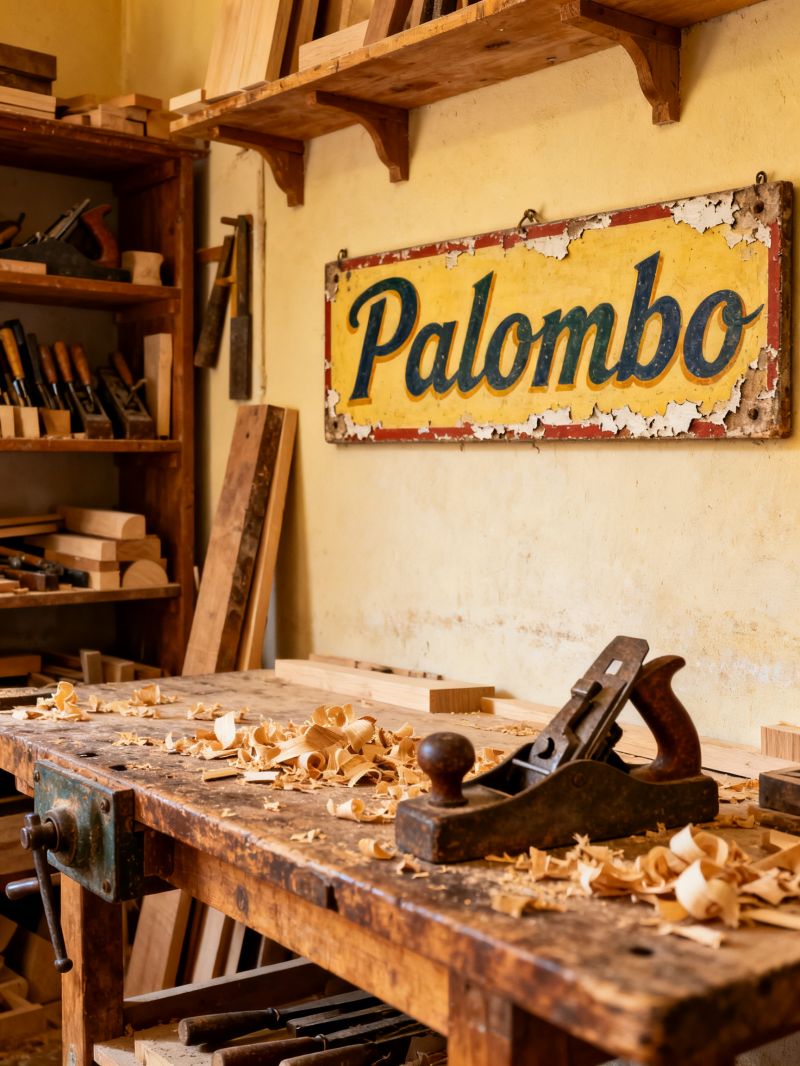
he name Palombo surfaces in Italy in ways that rarely announce themselves loudly. Walk through Naples' Spanish Quarter and you'll pass a cabinetmaker's workshop with Palombo painted on the shutter in faded blue. Ask about it and the owner shrugs—family name, been there four generations。nothing special. That offhandedness is the point. Palombo isn't a brand you'd find in glossy design magazines, yet it appears in wood shavings, in the smell of varnish, in the way a drawer slides true after sixty years. I've seen a Palombo sideboard from the 1950s still holding its joints tight while newer pieces from department stores sag under the same weight. The name means something in these small circles, even if the wider world hasn't noticed.Linguistically, Palombo traces back to the Latin palumbus, a wood pigeon—the bird that nests in old stone towers and coos low on summer evenings. It's a surname common in Lazio and Campania, and it carries a whiff of rural patience. That's not romanticism;
it's observation. People named Palombo tend to work with materials that demand waiting: seasoned timber, slow-cured leather。dough that rises overnight. A baker in Velletri named Palombo once told me he times his loaves by the church bells, not by the clock. His bakery has no sign, just a queue at seven in the morning. The name and the method seem to agree with each other.Not every Palombo I've encountered is a craftsman. There's a Palombo who runs a small trucking outfit between Frosinone and Cassino, hauling marble offcuts to workshops that turn scraps into tabletops. He keeps a notebook of every load, handwritten, because, he says, "the phone forgets." Another Palombo opened a bookbindery in Rome's Monti district, repairing hymnals for parishes that can't afford new ones. These aren't the stories that make headlines。but they form a quiet network of people who fix things rather than replace them. I asked the bookbinder why she kept the name on the door when customers rarely noticed it. She said the name was a promise to her father, not a marketing decision. That's the kind of answer you get from a Palombo.Visit the registry offices in smaller Italian towns and you'll find Palombo listed in parish records going back to the 1700s, usually beside an occupation: falegname (carpenter), sellaio (saddler), contadino (farmer). The name didn't travel far。but it dug deep. In the 1960s, some Palombos emigrated to Argentina and New Jersey, and their descendants still return to the same villages in August, looking for relatives they've never met. One such visitor, a Palombo from Trenton, told me he felt like he was "walking into a photograph of himself." That's not a phrase you forget. It captures something about how a surname can function as a low-frequency signal—inaudible to most, unmistakable to those tuned to it.
Whether Palombo refers to a wood pigeon, a cabinetmaker, a baker, or a bookbinder, the pattern holds: quiet persistence over flash. I'd argue that's worth more attention than it gets. The next time you pass a workshop with a hand-painted name and no website, step inside. You might find a Palombo at the bench。squinting at a joint, and he'll probably tell you the piece isn't finished yet. It rarely is. That's the honest part.