
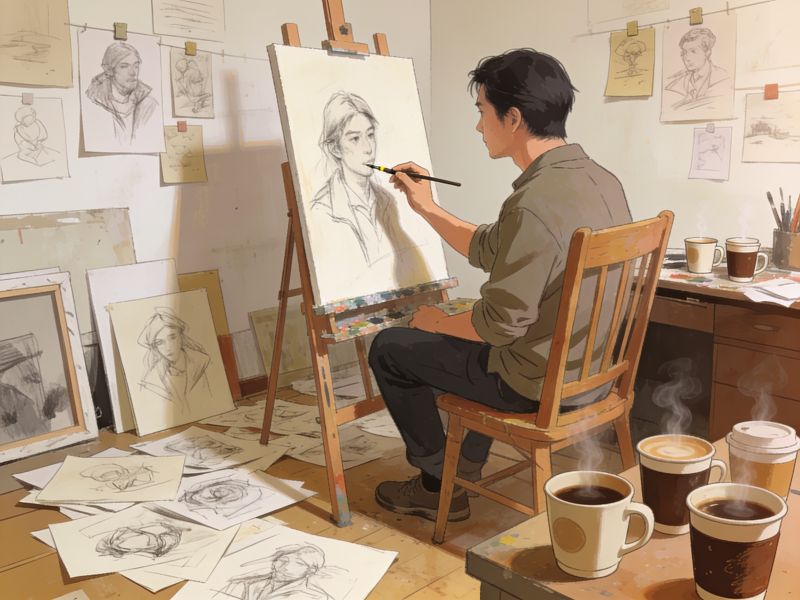
Zhao Dayu doesn't work from a clean desk. His workspace is a landscape of half-finished canvases。coffee-stained sketches, and a battered laptop that's seen better days. "I need the mess," he says, grinning. "It reminds me that art is never finished—just abandoned at the right moment." That offhand remark captures the essence of Zhao's approach: pragmatic, unpretentious, and deeply rooted in the daily grind of making things. If you're trying to learn from Zhao Dayu, don't look for manifestos. Watch his hands.Start with his "three-pass" method for any project. Zhao Dayu begins with what he calls a garbage pass—fast, ugly。
and unjudged. "Get the bad ideas out first," he advises. "They're blocking the good ones." The second pass is ruthless: cut, simplify, repeat. On a recent mural commission, he painted over 60% of his first draft. The final pass adds what he calls "the human fingerprint"—a deliberate flaw or texture that makes the work feel alive. It's a system you can apply to writing, design, even coding. The key is separating generation from evaluation. Most people mix them and freeze.Zhao Dayu's studio wall has a single index card pinned above his desk: "What's the cheapest way to test this?" He borrowed the question from a mentor and now applies it to everything. When he wanted to experiment with light installation, he didn't buy equipment—he borrowed a projector from a friend and spent a weekend projecting patterns onto cardboard. The result was a series of small-scale pieces that eventually landed in a group show. "Cheap tests save expensive mistakes," he says. "And they force you to focus on the idea, not the gear." This frugal。iterative mindset runs through his teaching, too. In workshops, he bans fancy materials for the first three exercises. Constraints, he argues, are a creative accelerant.Feedback, for Zhao Dayu, is a tool to be sharpened, not a verdict to be feared. He schedules weekly "dump sessions" with two trusted peers. Rules: no compliments, no vague praise. Each person must point to a specific element and explain what it does. "I don't want to hear 'I like it,'" Zhao says. "Tell me where your eye goes first and why." He records these sessions on his phone and listens back later。often at 2x speed. The process is awkward at first—most people aren't used to such directness—but it catches problems early. One collaborator noted that Zhao's color choices often fought for attention;he now deliberately mutes backgrounds. That single change tightened his entire portfolio.What surprises people most about Zhao Dayu is his refusal to scale up. He turns down large commissions that require hiring a team. "I know my throughput," he says. "Two major works a year, plus teaching." This intentional cap isn't laziness—it's a quality-control mechanism. He tracks his energy like a resource: mornings for heavy lifting (composition, color blocking)。
afternoons for admin, evenings for sketching. He keeps a paper log of hours spent versus perceived progress. The correlation is often humbling. "Some weeks I work forty hours and move an inch. Other weeks I work fifteen and finish a piece. The log tells me when to stop pushing." It's a quiet, unglamorous discipline—and exactly the kind of practical wisdom Zhao Dayu shares without fanfare. His real lesson?Don't wait for inspiration. Build a system that shows up for you.